

Assisi – ITALY — On February 21, 2026, the extraordinary exhibition of the remains of St. Francis was opened in the Lower Basilica dedicated to him in Assisi. The initiative received the authorization and blessing of Pope Leo XIV and has its roots in the encouragement expressed by Pope Francis as early as December 2023.
As we all know, this initiative is part of the celebrations for the 800th anniversary of the death of St. Francis, or rather his Transitus, his passage from life to true life. It has been, and continues to be, a special time for the entire Franciscan family and the universal Church, and we want to embrace it in harmony with the Gospel dictum of the seed that dies to bear fruit (cf. Jn 12:24): truly, the Poverello of Assisi continues to bear fruit in the world, now for eight centuries, through a host of sons and daughters who look to him as the authentic interpreter of the Gospel.
Looking at the mortal remains of Francis “It is an invitation to consider each person’s personal life in a similar light: like Francis, each person is called to give themselves generously in relationships, to become this living tree of fraternity that continues to bear fruit in the history of the Church and the world,” said Fr. Marco Moroni OFMConv, Custos of the Sacro Convento, when he presented the event and was interviewed by journalists at a press conference held shortly before it.
During the weeks leading up to the event, preparations for the Ostension included significant moments, such as the inspection of the sarcophagus on the night of January 9, 2026, in the presence of several friars from the Sacro Convento and the Most Rev. Domenico Sorrentino, bishop of Assisi-Gualdo Tadino-Nocera Umbra and Foligno. An interesting note: the sarcophagus is sealed with two keys, called “S” and “F,” one in the possession of the bishop of Assisi and the other in the hands of the custos of the basilica. On the morning of Saturday, February 21, in the presence of some friars from the community of the Sacro Convento as well as experts, the mortal remains of St. Francis were exhumed from the sarcophagus in which they rest, “preparing” what would be needed in the afternoon of the same day to begin the exhibition. The friars of the two papal basilicas in Assisi (St. Francis and St. Mary of the Angels at the Portiuncula) had the opportunity to visit Francis’ tomb privately before the exhibition.
Celebration of Vespers and Commencement of the Exhibition
On the afternoon of February 21, at 4:00 p.m., the transfer of the mortal remains, relics of St. Francis, from the Crypt to the Lower Basilica began, placing them in front of the main altar, with a small procession composed of friars from various Orders, Bishop Domenico Sorrentino, under the presidency of Cardinal Ángel Fernández Artime, Papal Legate for the Papal Basilicas of Assisi. The assembly of friars waited in the Lower Basilica, accompanying the procession with singing.
This was followed by incense and the celebration of Vespers I of the First Sunday of Lent. Everything took place in an atmosphere of simplicity and fraternity, symbolically involving all the friars of the world as one family of the sons and brothers of Francis.
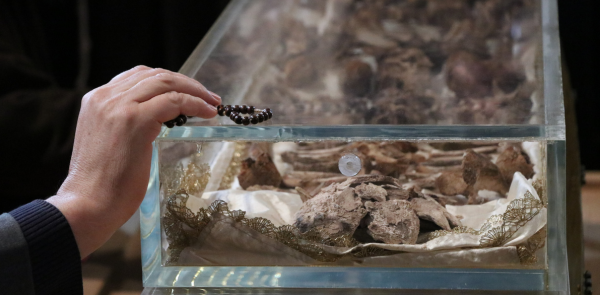
In his homily, Cardinal Ángel Fernández Artime strongly emphasized that the exhibition “is not a nostalgic look at the past, but a strong and concrete invitation for our present.” Pointing to the remains of the Poverello, he reminded the faithful that they were witnessing a silent but powerful sermon, which shows “ a body consumed by love, marked by the stigmata, bent by penance, but radiant with peace “. The bishop urged, “It is a time offered for conversion. We are not here out of curiosity, but to allow ourselves to be challenged, to contemplate fully what the Gospel can accomplish when it is taken seriously.”
The Cardinal’s words follow on from those of Pope Leo XIV, who recalled in his message at the opening of the Centenary of the Transitus that St. Francis represents “good news” even for non-believers, embodying the concrete possibility of a human life based on peace, mercy, and acceptance rather than competition, war, and violence.
Immediately after vespers, the friars present were able to remain in the church for about an hour in silence and contemplation before the remains of St. Francis.
Until now, access to the basilica has been reserved for a limited number of friars, religious authorities, journalists, and organizers. From the following day, Sunday, February 22, the doors have been “opened” to all those who wish to experience this pilgrimage.
Attendance at the Event
About 300 friars from various orders of the Franciscan family participated in the event, along with more than 200 journalists from around the world and 400 volunteers who will assist during the public exhibition. According to the communications office of the Sacro Convento, on the evening of the event there were approximately 370,000 reservations for veneration, coming from five continents.
A bit of history
Until now, the saint’s remains had never been visibly displayed to the general public but had been the subject of closed-door inspections called “ricognizioni”. In 1978, on the occasion of the “third ricognizione” of the saint’s remains, the opportunity was taken to hold a public exhibition in the Chapter hall of the Sacro Convento for veneration, which lasted 18 days (from February 15 to March 4). For this reason, the current exhibition can be described as the first public extended exhibition of the saint’s mortal remains.
Here are some key facts concerning the saint’s mortal remains.
1230 – Transfer and Concealment. Francis’ body was transferred from the church of St. George to the new Basilica of St. Francis in Assisi. To avoid the risk of relic theft, common at the time, the body was hidden deep beneath the high altar, protected by heavy stone and iron structures.
1818 – The Discovery. After fifty-two nights of secret excavations, on December 12, 1818, the body was finally found under the altar of the Lower Church of the Basilica. On that occasion, the remains were removed for a brief scientific examination and religious homage before being placed back in the stone sarcophagus that can be seen today.
1978 – Scientific examination. An examination of the mortal remains was carried out to assess their state of preservation, and they were displayed for a short time. On this occasion, it was confirmed that only bones and ashes remained of the body.
1994 and 2015 – Private inspections. Over the years, there have been other inspections for reasons of study, conservation, and devotion, but these have always been “private” occurrences, reserved for Franciscan communities, experts, and bishops.
May our veneration of the body of St. Francis inspire us to renew our commitment to the Gospel. May we rediscover that universal message of “littleness” which reflects his evangelical life and confirms our promise to be lesser brothers in the world.
An Extended Experience of Prayer
The extraordinary exhibition of the remains of St. Francis will continue uninterrupted until March 22, 2026. This exceptional month represents a universal invitation to rediscover the legacy of the Poverello of Assisi, a man whose message of peace and brotherhood continues to speak deeply to the heart of humanity. As the friars remind us, remembering his death means celebrating his life and the impact that, after eight centuries, continues to inspire believers and non-believers alike. May this veneration inspire us all to rediscover the evangelical “smallness” that makes us “great,” so dear to Francis.
This time of grace will be enriched by a full calendar of religious and cultural events. The culmination and conclusion will be on Sunday, March 22, at 5:00 p.m. in the Upper Basilica, with a solemn celebration presided over by Cardinal Matteo Maria Zuppi, Archbishop of Bologna and President of the Italian Episcopal Conference.
For those who wish to participate in this extended prayer experience, please note that veneration of the remains is reserved exclusively for those who book through the only authorized portal (www.sanfrancescovive.org). Admission on weekdays is allowed from 7:30 a.m. (on weekends from 7:00 a.m.), with closing scheduled for 7:00 p.m.
